
BLOG
Domke Ruggedwear Bags: Wax Problem?
Apologies for yet another Domke blog post, but I thought this would be interesting to those of you debating on buying a regular canvas bag or a Ruggedwear waxed canvas version. You don’t have to search too far on the internet on the subject of Domke to come across the great wax debate. In one corner you have the rugged wear users that swear the wax gets everywhere and all over bodies and lenses. In the other corner, you have the users that say this is just not true and that their bag had zero wax transferring to their hands. Well, I’m here to tell you that they are both wrong…I mean both right…eh.
I have owned a Domke F-3x Ruggedwear bag for about a year and a half, and now, having just bought a Military Green F-803 Ruggedwear version, I have found both sides to be correct.
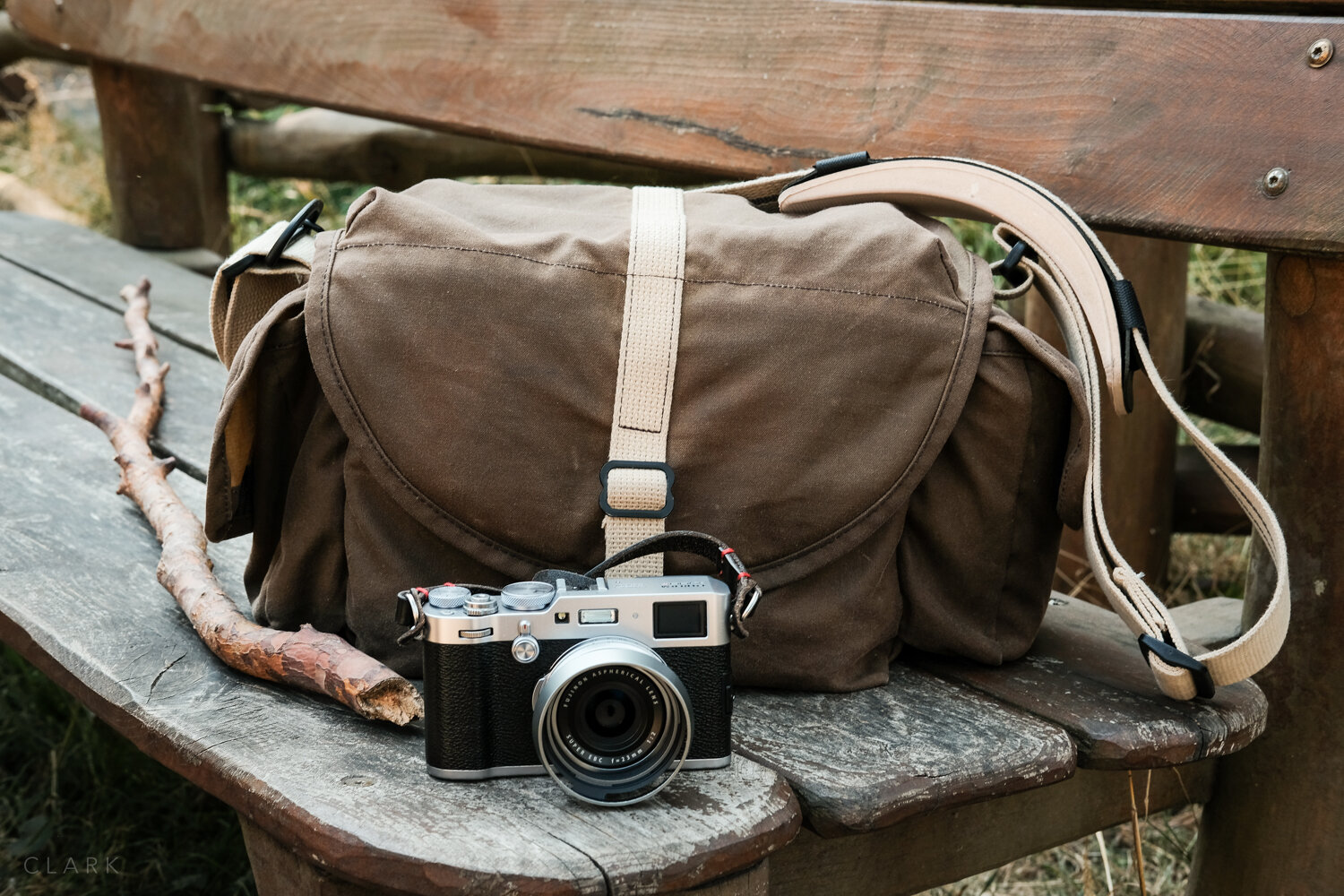

My Domke F-3x Brown Ruggedwear when it was new (left) and as it is now, dirtier but less waxy!
THE DOMKE F-3x BROWN RUGGEDWEAR
You can read my Domke Or An Ass post about the F-3x Ruggedwear and how I thought it might be a fake at first because the material was rather thin. But I just want to focus on the wax here. When the F-3x arrived from Amazon UK it didn’t look as though it had a lot of wax on it, definitely not compared to some I had seen on Google Images. But it was waxy to the touch, and being the type of person that hates having sticky or greasy hands, I wanted to get rid of the wax as much as possible.
I know some people will ask why I would buy the Ruggedwear version if I didn’t want the wax, but I like the rougher look and the softer material. I have a black canvas F2 for my music photography bag, which is great, but it takes a long time to break in and soften up.
So I put the F-3x out in the sun and then wiped the excess wax off when it melted. I even used a hair dryer at one point. Some people recommend putting the bag in a dryer with a towel, but I don’t have a dryer. But now my F-3x is much less waxy and I enjoy using it. Domke doesn’t recommend machine washing Ruggedwear bags, but that’s probably just to make sure the bag stays waterproof.

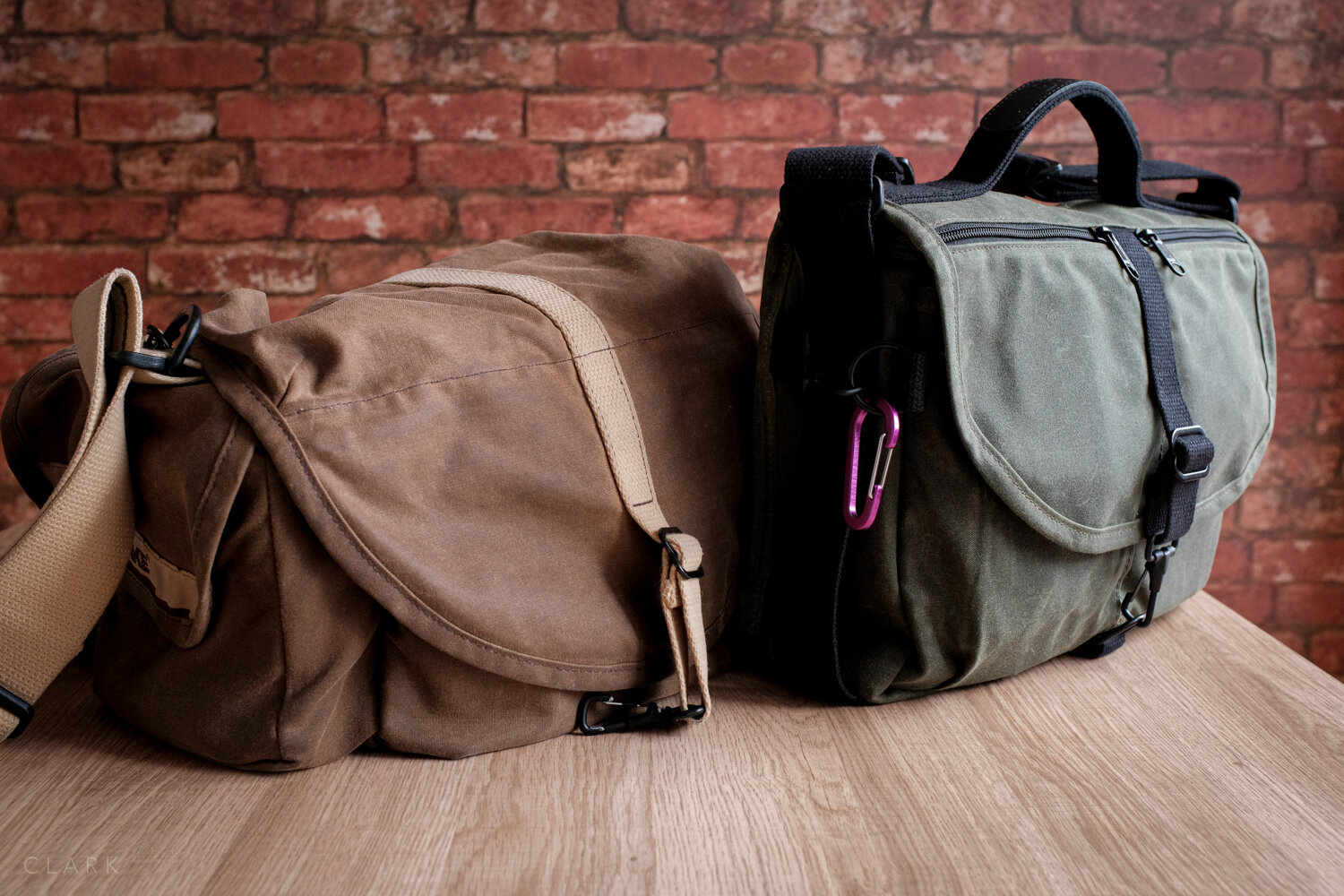
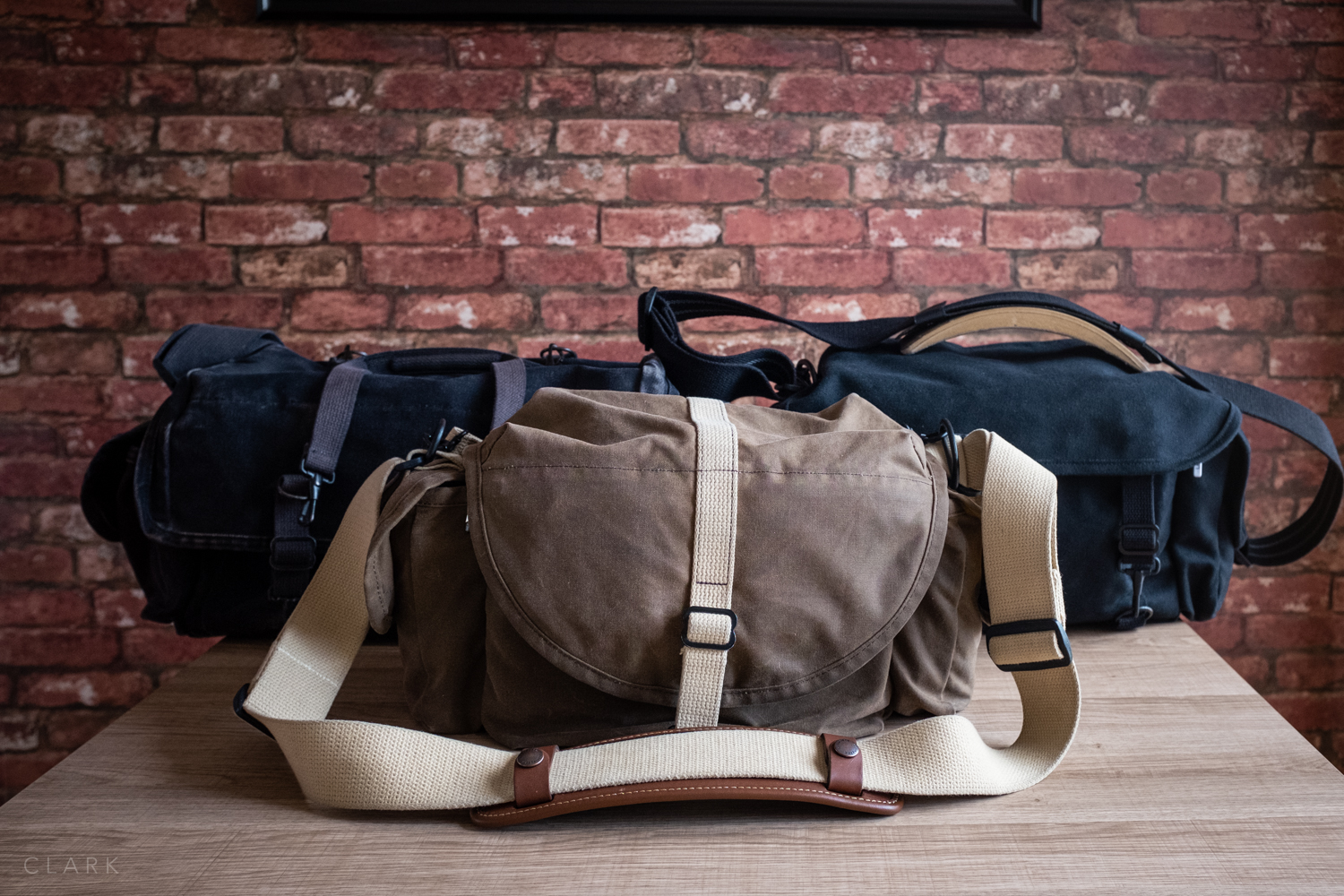
My newly acquired Domke F-803 Military Green Ruggedwear and the well-worn black canvas version
THE DOMKE F-803 MILITARY GREEN RUGGEDWEAR
Although I have an old and worn black canvas F-803 that is really soft and comfortable to use, I have been on the lookout for a Military Green version of the F-803 of the F-3x. So when an F-803 Military Green Ruggedwear showed up on Amazon recently, I bought it straight away, even though it was in the US and I am in Scotland. I wondered if the wax would be a problem and I had decided that I might just risk it and throw it in the washing machine a few times.
But when the new F-803 arrived, I was pleasantly surprised that it didn’t feel waxy at all, even though it looks waxier than the F-3x did when it was new. I can rub my hands on the surface and there is zero wax transferring on to my skin. I can put notebooks business cards or even my Fuji x70 into the front pockets without worrying they will get wax on them. The material of the F-803 feels slightly thicker and stiffer than my F-3x, but maybe the latter was like this when new too.



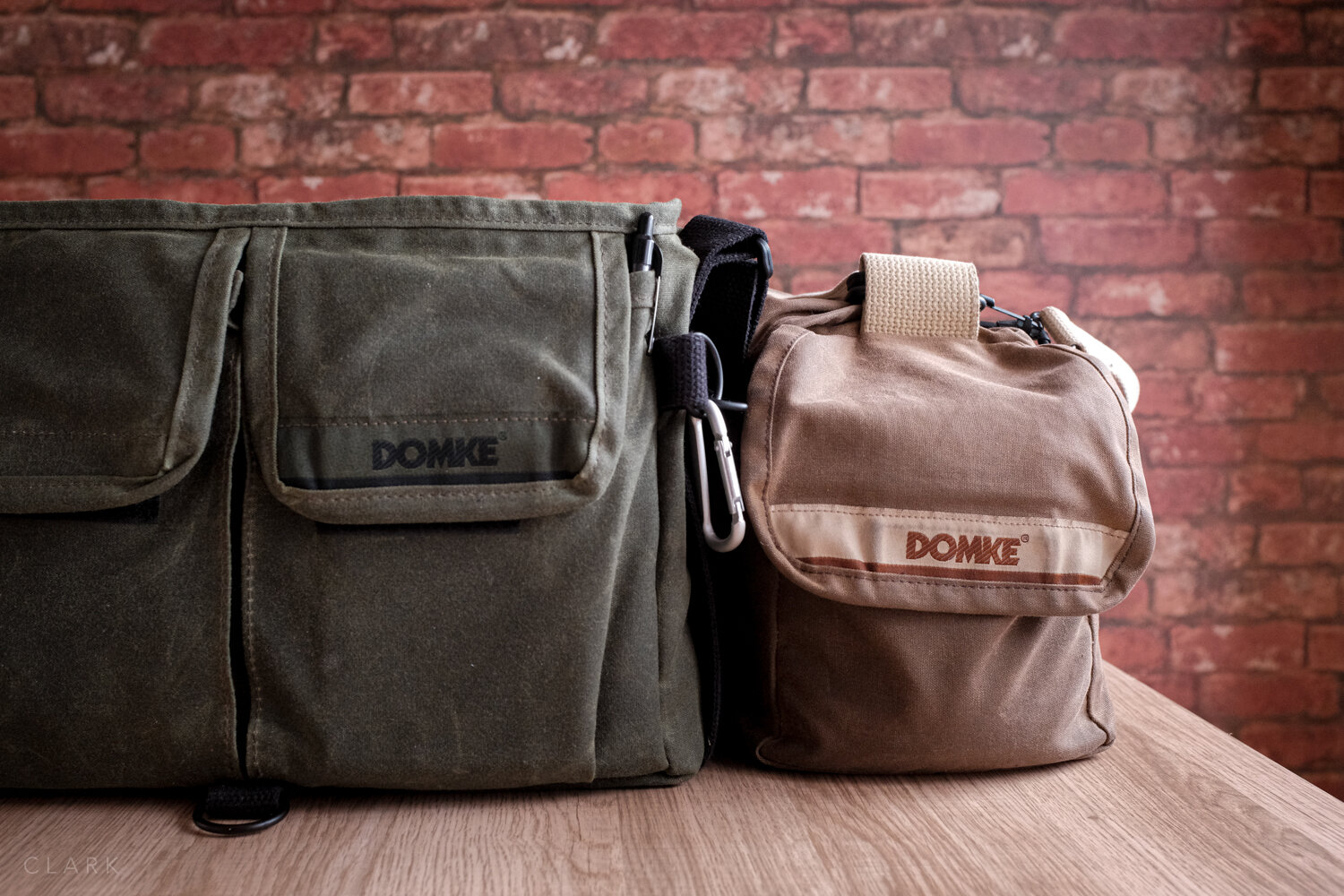
The Ruggedwear version of the F-803 does have a green lining on the inside and under the top lid, which the the canvas version doesn’t have (neither does my F-3x). This makes the bag feel a bit more higher quality than the others.
The extra lining of the F-803 Ruggedwear bags is a nice touch.
It was a bit of a gamble buying this Military Green Ruggedwear version of the F-803. I could get away with putting an insert in to protect my cameras from getting wax on them, but I use the front pockets of the F-803 series a lot for notebooks, pens, business cards, batteries etc. My worsed case scenario was returning it or selling it on Ebay, but I’m really happy with this bag and I’m looking forward to putting it through loads of abuse during the next few years. It will easily carry an X-Pro2 with attached 35/2, an X100 series, and either a couple of extra lenses or my X70 (or all of that if I really had to). The two little zipped pockets on the outside of the bag are an added bonus and are good for spare memory cards and business cards. They are also a great place to keep train tickets or packing tickets as they are always quickly accessible. There is also a pocket on the back large enough for an iPad.
There is a Fujifilm version of this bag in sand-coloured Ruggedwear. If any of you own one of them maybe you could mention in the comments if they suffer from being waxy or not?
MORE DOMKE POSTS


One Frame 004: Jeremy Corbyn

I was heading to the Edinburgh Fringe with a couple of Friends (both called John) to shoot some pictures. We had decided all three of us travel there on the train so we could have a chat on the way. As we got off the train, one of my friends mentioned that Jeremy Corbyn was walking behind us on the platform. I asked who he was and John said he was about to become the leader of the Labour Party and possibly the UK’s next prime minister. So I spun around and shot a frame (which was out of focus). I grabbed another one as the entourage went through the ticket barriers (the one above).
That was back in August 2015 when I knew nothing about politics. Fast forward to today April 2020 - I still know nothing about politics, but I do know Jeremy Corbyn is not the prime minister. I don’t think he’s even the leader of the Labour Party...but I could be wrong.
I don’t vote and I couldn’t care less who is in power in Scotland or the UK. To me, they will all do as good or bad a job if it, they just move the chess pieces round differently. But I do think my impartiality would make me the ideal photographer to cover political event…I would just need somebody to point out who is who :o)
SHOT WITH FUJIFILM X100T
What's In A Music Photographers Bag
I sort of fell into the genre of music and over the last seven years, I’ve shot more than 300 artists and taken more than 50,000 pictures as a music photographer. I shoot all types of music, but mostly jazz. I am currently the official photographer for the Scottish National Jazz Orchestra (SNJO) and my pictures have been featured on album covers, tour posters and magazine publications. At the time of writing this post, I am putting the finishing touches on a book featuring the last 7 years with the SNJO.
THAT WAS THEN
There was a time when I shot Nikon alongside my Fuji’s, but with the release of the Fujifilm XF50-140mm f2.8 my D800 (amazing camera) ended up staying at home, and after six months or so of no use my full Nikon kit was sold. I also used a Lowepro backpack for a long time, but as I often have to pull my camera back out of the bag just as I am about to leave a venue, a shoulder bag is the way I go these days (mostly).
THIS IS NOW
These days I am using a Domke F2 (black canvas) bag. It’s not a massive bag, but it’s not small either. What I can fit inside the F2 is about as much weight as I want to carry and as it is packed full, I have to take out a lens if I want to include a different one. This works well for me as I would end up carrying way to much gear otherwise. If I know I’ll be shooting a lot of backstage pictures I might wear my belt-pack to the gig and put an X-Pro2 body in one of the side pockets as I prefer a rangefinder-style body for that sort of shooting.


SIDE POCKETS
Starting at the F2’s side pockets. I have a BlackRapid Yeti double harness strap, a Manfrotto Pixie mini tripod and a Spider Holster in one pocket, and a small pouch that attaches to my belt in the other pocket.
BLACK RAPID YETI
The BlackRapid strap takes up a lot of room and I have thought of getting rid of it and using regular straps many times, but this harness works well and is easy to adjust quickly for one camera or two.
SPIDER HOLSTER
The Spider Holster is rarely used but can be handy when using a third camera. I keep the spall spanner/wrench in my belt pouch for attaching the little stud to the bottom of the camera.


BELT POUCH
These tactical pouches are available on Amazon for very little money and are essential for what I do. I put this on my belt as soon as I arrive at the venue and it saves me from having to get to my bag (which can be at the side of the stage) for essentials. I keep a notebook, pens, spare batteries, SD cards, business cards and a lens cleaner in this. It also has a section on the outside for my iPhone, which I insert upside down, face inward (and muted) so that it doesn’t light up on its own.
LOWEPRO PADDED WRAP
I have had this green Lowepro padded wrap, that came with another bag, for years. It is folded like an envelope and mostly just lies on top of my gear as the F2 doesn’t have any padding. I keep an iPad mini in the zippered pocket on the lid of the F2, which protects the screen on the back of my camera, but the wrap is just added protection. It can also come in handy for kneeling on or a number of other uses.
INSIDE THE BAG
FUJIFILM X-T2 AND XF 16-55mm F2.8 WR
The Fujifilm XF 16-55 f2.8 lens is attached to my X-T2 most of the time and this the camera and lens combo that I keep handy at the top of my bag so that I can pull it out or put it back in the F2 easily. It sits in the bag with the lens facing down. This comes in handy when leaving a venue as I often have to pull a camera out for a few shots, or if I keep it out it means I can slip it back in at the venue door without needing to remove the bag from my shoulder. Something the backpacks are not functional for.
THE FUJIFILM X-T3
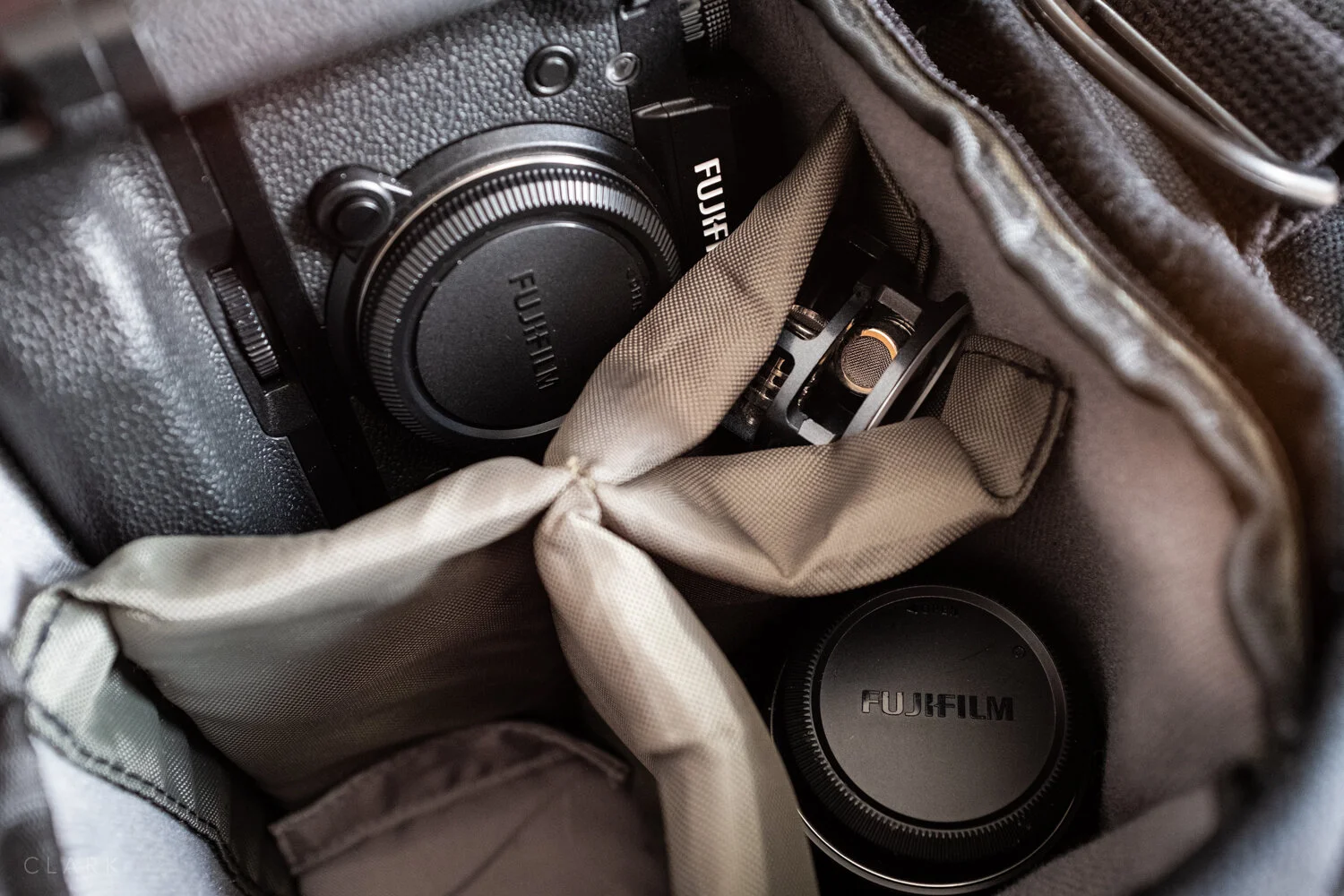
The amazing 50-140 f2.8 lens is my concert workhorse. It can’t fit in the Domke attached to my X-T3, so the camera body fits inside the F2 square insert. These inserts are divided into 4 sections for lenses, but unlike the older versions that were sewn, the newer ones have Velcro so the section can be adjusted to take the X-T3 with the battery grip attached. This also creates a space for my Zoom H1 audio recorder (more on that later). I attached a spare Billingham Velcro insert above the X-T3 that acts as a hinge and folds over to protect the X-T3 and X-T2 from bumping into each other.

SWITCHABLE LENS
Still on that square Domke insert (this one is included with the F2). I have the 23mm f1.4 lens in the photo above, but this is where I keep my switchable lens. By switchable, I mean that if I need to bring another lens, it will go in here and the 23mm will stay at home. This stops me from carrying too much equipment and weight (more on these extra lenses later).
Front pocket contain audio equipment (left) and white balance tools & business cards (right)


LENSES
I have a 16mm f1.4 and a 56mm f1.2 stacked in a tall square Domke insert I bought on Ebay. I use the JJC square metal lens hood on both these lenses (and the 23/1.4), so they can be stacked safely as they have flat plastic caps. I highly recommend these lens hoods. They are equal in quality to the Fuji optional ones, but less expensive.
The 50-140mm f2.8 workhorse lens sits inside a Domke insert that comes with an F-4AF bag. This insert is a bit wider and has the space required to include the tripod mount on the lens. I attach the BlackRapid strap to the tripod mount instead of the camera as the weight of this heavy lens would put too much strain on the camera’s lens mount.
NISSIN i40 FLASH
I rarely use flash for music photography (never ever for shooting during a concert), but sometimes I might need to use it for a backstage portrait if the light is really bad. The Nissin i40 is small and slips in the F2 between the sidewall of the bag and the smaller of the lens inserts. It sits in there and I forget about it until I need to remember. The i40 runs on 4 AA batteries and has enough power for anything I need on a music shoot. If I am required to shoot promotional portraits or promo shots, I will take a bag full of Yongnuo YN560 IV’s, stands and modifiers. But that’s another story.


AUDIO EQUIPMENT
After being asked to shoot some after-show video clips and interviews without any notice, then having to cobble a less than ideal setup to get by with, I now always keep a small audio kit with me. You have already seen where I keep the Zoom H1 inside the main compartment of the F2, and the Manfrotto Pixie that can be used as a tabletop tripod for shooting video. I use one of the front pockets to store a Rode lav microphone and extension cable (including an adaptor to allow it to fit the X-T3 or my iPhone). I also have a set of Apple earbuds for monitoring sound and a spare 3.5mm to 3.5mm cable that can be used to attach the Zoom H1 to the X-T3’s headphone socket. So I can record audio in camera, lav mic to Zoom H1 or both at the same time.
WHITE BALANCE
The other front pocket of the F2 is used for business cards and white balance tools. I have a Color Checker Passport, ExpoDisc and a set of white balance cards on a lanyard. Overkill? Perhaps. I also use this bag for portrait shoots so the Color Checker is invaluable.


OPTIONAL LENSES
The three lenses that I often swap out when needed are the 12mm f2.8 Samyang, the Fuji 10-24mm f4, and the awesome Fuji 90mm f2. These lenses all have their use, but it can often depend on the venue or the job. For instance, The 12mm Samyang is useful if I can get on stage behind a band or orchestra and shoot toward the audience.
CARDS AND CLEANING
I also take a JJC SD card holder (stored in with the white balance tools) and both the RocketBlower (F2 side pocket) and a Lens Pen. I also have a lens cloth in my belt pouch. I don’t use lens caps so like to clean my lenses before a show.
iPAD
It’s not shown in the photos, but I also keep an iPad Mini inside the zipped pocket in the top lid. I often send a couple of pictures during the interval from a camera to the iPad using the built-in wifi feature. I edit these using Snapseed and then send them to the client so they can be used on Facebook to promote the following night’s performance. It saves me having to do it when I get home.
Lowepro CompuTrekker 350 backpack, Domke F2 and the Domke F-1x
OPTIONAL BAGS
If I really must take extra gear I can use the larger F-1x (bottom right in the picture above) which can hold a massive amount of gear but can get too heavy. Or I might opt for the LowePro Computrekker 350 backpack if I’m travelling by train and have a long walk to the venue.
A FEW LAST TIPS
Always have more than one camera.
Always have at least one camera with a lens attached in your bag.
Always keep spare batteries and cards on your body.
Use a belt bag or pouch to carry your spares and phone.
Make sure you get a photo pass from the venue or the client.
Lock in your white balance, it will save you hours of editing time later.
Shoot completely manual. I tend to shoot at f2.8, /125th of a second and adjust my ISO using the front command wheel.
Clean lenses before a show.
Sync camera clocks before the show (see below if you forget).
Make sure you have enough space on SD cards for the full show.
SYNCHRONISING CAMERA CLOCKS AFTER THE SHOOT
It is crucial to synchronise the clocks on all cameras used on a shoot. It’s always better to do this before the gig, but it’s very easy to forget. So here is a method I use when I get home. I use a world clock app called ClockZ which constantly updates the time and is extremely accurate.
Shoot a photo on each camera of your phone while it displays the world clock time.
Ingest all the pictures from your shoot into Lightroom.
Press G on your keyboard to enter Library Module Grid Mode.
Click on Metadata above your pictures.
In the camera section, choose one of your cameras.
Now go to the last picture you shot (which should be the one of your phone).
Click on that picture.
Hold down Command (Ctrl on Windows) and press A on your keyboard to select all.
Now ho to the Metadata menu at the top of your screen and choose Edit Capture Time.
Make sure ‘Adjust to a specific time and date’ is checked.
Input the time & date from the picture of your phone into the ‘Corrected Time’ section.
Click ‘Change’. It will warn that this can’t be undone but don’t worry about that.
Now repeat the process for your other cameras and all your pictures will be in sync.
If you have found this post helpful and you are thinking of buying any of the gear I use? You could help me out (at no cost to yourself) by buying from Amazon UK using the links below. Thanks.
One Frame 003: Out Of His Shell

While leading a street photography walk for Fujifilm UK during London Photo 24 back in 2017. I took the group of photographers through Camden Market. On our way out the back of the market and over the bridge, this man was standing, coffee and walkman in hand, looking like Touché Turtle with a gym membership. Impressive for a man of his age and he was quite happy to show it off. Although this scene looks scarce of people, there were hundreds behind me.
I could have taken the sign on the wall behind him and taken this post in a different direction - but let’s not go there.
SHOT WITH FUJIFILM X70
One Frame 002: TV Guys


While walking through some narrow alley-ways in Barcelona, I came to a point where I could either turn left or right. But the light coming in from above, paired with the graffiti on the shutter in front of me was interesting. So I waited for someone interesting to pass through the viewfinder of my X-Pro2. A few people moved in and out of the frame, including girls that couldn’t make up their mind which way to go, or couples out for a stroll. But if you wait long enough something interesting will happen.
Suddenly these two guys walked through the frame carrying a large TV and I knew at that moment that I had the frame I had been waiting for. It didn’t occur to me until much later that there is a great shot by Magnum photographer Abbas in his ‘Return To Mexico’ book that has a similar picture. Now I couldn’t have predicted these guys would walk into my frame, so no copying occurred. Abbas has the best shot of course as it has a better TV and the dog is the icing on the cake. But I do like my Barcelona shot too.
SHOT WITH FUJIFILM X-PRO2 & 35/2
One Frame 001: School Days
INTRODUCTION TO ONE FRAME
This is the first instalment in a new series called ‘One Frame’ where I’ll be taking a single frame from my archive or something recently shot and giving some details around it. That could be technical information, background, what was happening in the scene, composition, or even just trying to explain why I like a certain picture, even though some wouldn’t consider it a good shot. These single frames will often be street photographs, but anything goes in this series. I’ll keep it loose!
SCHOOL DAYS
The picture above was taken by me when I was in high school. My science teacher Bobby Heard actually set the camera up on a tripod and placed a chair behind it so that pre-growth-spurt me could reach the camera, look through the viewfinder and press the button. This might have been first or second-year pupils (12 or 13 years old) but I really can’t remember.
What I do remember is the thrill and fear of this experience and going straight to the darkroom in the science lab, processing the film and printing a few copies. One of these copies I still have to this day, mounted on brown board and kept in a bag with clear plastic on one side and paper on the other. I was hooked, and spent a lot of my school time in the darkroom when I should have been in English or Maths…probably why my spelling is so bad to this day.
The chemist that I bought most of my film off around that time was selling a Knome Beta II enlarger, so I convinced my dad (who didn't take much convincing) that I needed that enlarger, some trays and chemicals, to set up a darkroom in the house. I still have that enlarger and those trays to this day.
Hopes For A Fujifilm 18mm F2 MkII

Mock up of how I would love to see a new Fujinon 18mm f2 with true manual focus instead of by wire
There are probably three popular choices when it comes to street photography lenses. There’s the 50mm, 35mm, and the 28mm (in full-frame terms). In a crop factor of 1.5 like the Fujifilm X-Series cameras have, that would be 35mm, 23mm, and 18mm. We already have 2 versions of the XF 35mm and 2 versions of the XF 23mm (more if you include the XC series). But the original 18mm f2 sits on its own and compared to the newer Fujicron lenses (as they have been nicknamed), like the 16mm, 23mm, 35mm, and 50mm, the 18/2 is getting long in the tooth.

The original Fujifilm 18/2 (left) and the Leica 28/2 Summicron (right). Leica do make beautiful glass
The Fujifilm X70 is still the best Fujifilm option for 28mm field of view for street photography at the moment, IMO.
HOPES AND DREAMS AS A STREET PHOTOGRAPHER
There are rumours that Fujifilm are working on two MkII versions of older lenses and I would think it would be two of the original lenses released along side the X-Pro1 in 2012. Those lenses were the 18/2 the 35/1.4 and the 60mm f2.4 Macro. My best guess would be that one of the new MkII lenses will be the 18'/s.
So as a street photographer, what I feel is lacking in the X-Series lenses is a proper street lens like the Leica 28mm f2 (above) and the Voightlander equivalent. So here is what I would love in a new 18/2 lens from Fujifilm.
Old school manual focus (not by wire) that has hard stops at either end of the focus range.
A depth of field scale printed on the lens that accurately matches that of the camera.
A similar size and shape to the 16/2.8.
A focus tab on the focus ring.
Feet and metres marked on the focus ring in bright, but different colours.
A small detachable metal lens hood.
I know what you are thinking - just buy a damn Leica 28mm Summicron. But A. I shoot Fuji cameras. and B. I couldn’t afford a Summicron (or any Leica gear).
Fujifilm make some of the most popular cameras for street photography. The X100V and the X70 are amazing and have fixed lenses. I highly recommend both. But the X-Pro series are fantastic cameras for street, especially having hybrid viewfinders. It’s frustrating as a street shooter that my chosen brand of camera has nothing to offer in a proper 28mm focal length that is up to the job of not only being able to autofocus but to be excellent at manual focusing.

ZONE FOCUSING
Street shooters like me often Zone Focus when out on the streets. But we also need the ability to quickly go from our prefered distance to either our close focus distance or infinity, especially on days where the light is low and we can’t shoot at f11 or even f8. A focus tab is ideal for this as it allows you to gauge focus ring distances without looking at the lens.
Who knows what Fujifilm will do if they actually make a new version of the 18/2, but I really hope they will think about what a 28mm (FF) focal length lens is mostly used for. Imagine if they also made a new 23/2 like this too! I’m sure they could win over many Leica and Ricoh street shooters with two reasonably priced Fujicron’s.with the best manual focus performance in the range!
The Domke F-3x One Year On
I wanted to do a follow-up to my review of the Domke F-3x that I wrote back in August 2018 called Domke Or An Ass. There’s so much more you pick up on a bag (or any product for that matter) after using it over a long period of time. Those things tend to be both good and bad. Probably the biggest thing I’ve realised about the F-3x (which would apply to a lot of Domke bags) is that it’s a blank canvas and should be adapted to the individual.
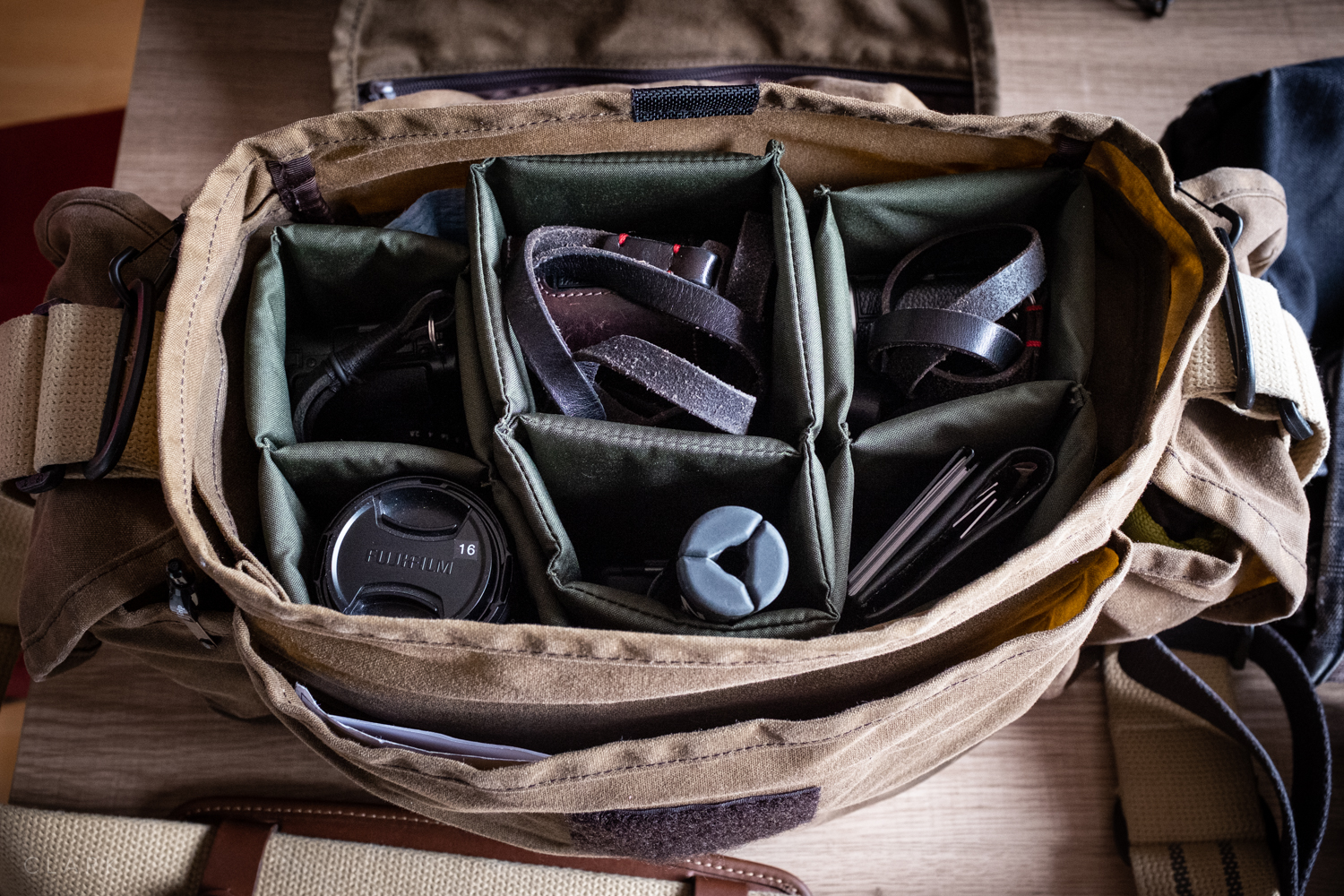
Top row (left to right) Fujifilm X70, X-Pro2 & X100F. Bottom row (left to right) Fujinon 50mm f2 & 16mm f2.8 lenses stacked, GoPro Hero 7, Fuji WCL-X100 lens & wallet.
BILLINGHAM SUPERFLEX INSERTS
I wasn’t keen on the setup of the F-3x main compartment as it had very little protection for my gear. Two very thin canvas loops (designed for lenses and a single piece of padding to keep two bodies apart is just not enough (for me at least). Smaller lenses can get under those bottomless canvas loops and go on a tour of the bag, visiting the rest of the gear inside with nasty results. So in my review, I used two different inserts. The Billingham Hadley Small is narrow, doesn’t really utilise the space of the F-3x that well, but is a good insert for the bag and provides a great amount of protection for the equipment inside. The Koolertron (seen in my review), although a great insert with good protection, didn’t really make use of the amount of space it took up, which was all of the main compartment. It also made the F-3x very boxy due to its tight fit and is the full height of the bag. Domke dividers didn’t give me the sizes I was looking for.
But then I came across the Billingham Superflex Partitions, a full range of fold-flat bottomless inserts that allow me to use the space in my F-3x more efficiently. The Superflex series are all 15cm in depth (back to front), which is almost perfect for the base of the F-3x (just overhanging slightly). The height and width of these dividers are in the names, with the last number always being the height. So a 9-15 is 9cm wide and 15cm tall (remember the depth is always 15cm across the range. A 10-18 is 10cm wide and 18cm tall. The F-3x can take the 18cm range comfortably, but I opted for the 15cm high ones as it provided a good depth for my cameras and lenses without having to dig down to reach my gear. It also leaves some room on the top for a scarf or a book if required, and lets the lid of the bag be a little more loose and floppy, which I like about the F-3x.

A view with the content pulled out slightly.
All of the Superflex inserts are divided into two compartments and there is a good amount of variation from size to size. The 9-15 is divided up into two sections of 9cm and 6cm, which is ideal for my X-Pro2 with a Gariz leather half case and either a 16/2.8, 18/2, or 35/2 lens attached in the 9x9cm part and then I can fit an X70 without a hood, or more small lenses. It’s worth pointing out that one compartment on each insert is always a square. So the first number of the name has that many centimetres square. 9-15 has a 9x9cm compartment, 12-21 has a 12x12cm compartment and so on (see diagram below).
My X100F sits nicely in the 8-15, which is divided up into 8cm and a 7cm compartments. So the X100F can fit in the 8cm space with lens hood attached and the X70 can fit in the 7cm space with lens hood attached too. My third and last Superflex divider is the 7-15, which like the 8-15 is divided up into 8cm and 7cm compartments. This one is ideal for lenses and accessories. Here is Billingham’s chart for the various sizes of Superflex inserts (the 9-21 to 12-21 won’t fit the F-3x, they are too tall). You can also find my review of the excellent Billingham Hadley Small Pro HERE.

These are the sizes available of the Billingham Superflex Inserts
THE WAX OF THE RUGGED WEAR BAGS
You can sit at a computer for days reading about all that has been written about the wax coating of these Rugged Wear Domke bags. In my opinion, they look good, but no-one wants to get wax on their hands that then gets transferred on to cameras and lenses. So I went through a phase at the beginning of leaving my F-3x outside in the sun and wiping the wax off with a towel as much as possible. Waterproofing is nice, but it’s not a massive deal for me, and if I really did get caught in a massive downpour I know that most of my kit is weather sealed. So one year in and the wax has been removed quite a bit by me and by natural use.

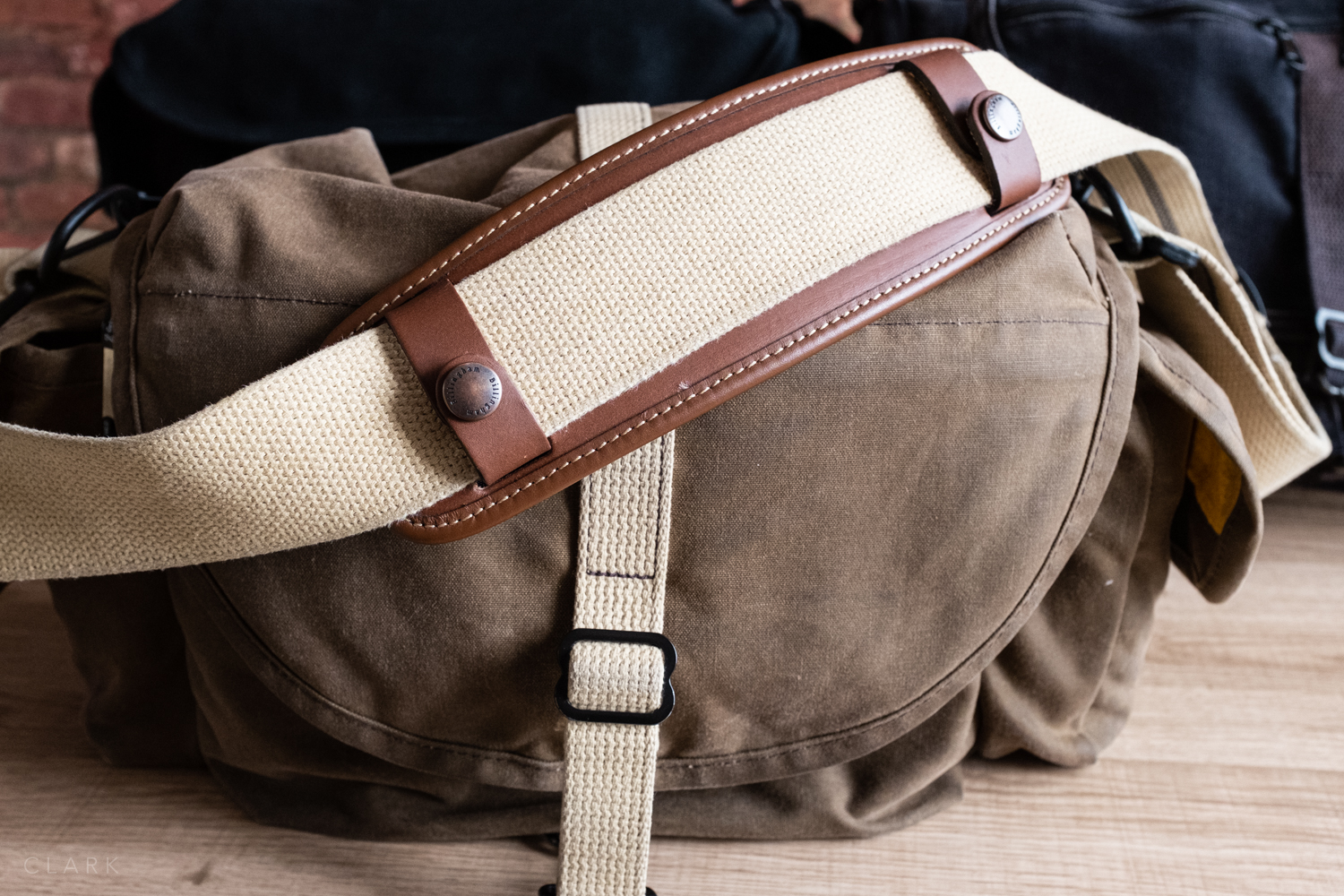
Domke Post Office Pad on the F2 Shooters Bag. The most comfortable shoulder pad I’ve used.
DOMKE POST OFFICE PAD
Domke’s Post Office Pad is an optional accessory that I bought at the same time as the F-3x. It can make a huge difference in the comfort of the shoulder strap when carrying a lot of heavy gear. I was very grateful for it on days when I had my Hasselblad system (500c/m, two lenses, two backs and a light meter) and the Fuji system together. But around the six-month mark I started to notice the glue that held the rubber padding to the plastic shoulder plate (that attached to the strap) was breaking down.

BILLINGHAM SP50 LEATHER SHOULDER PAD
Another option for a shoulder pad on Domke bags with a 2” strap is the Billingham SP50. These pads are well made and come in either Tan, Chocolate or Black leather. They have a decent amount of padding and look great, but the Domke Post Office Pad wins for comfort.
VELCRO ON THE MAIN FLAP
This is a negative point I’m afraid, but not a deal-breaker. The velcro on the main lid of the bag should have been twice the height that it is because unless the bag is stuffed full, the two pieces of velcro can miss each-other completely and be useless at holding the bag shut. This is a problem because Domke users tend to only fasten the metal clamps when in transit but rely on the velcro while working out of the bag.
One other slight annoyance is that the ring to attach the main clasp at the front of the bag seems to be under the bag rather than on the front. The clasps themselves tend to get a bad right-up, but I don’t find them to be a problem and I can easily undo the one on my F-3x one-handed while the bag is on my shoulder.
SLEEPING WITH THIEVES
After using the F-3x for a good length of time, I have found that they are pretty good for sleeping on while sitting in a chair at airports and hospital waiting rooms. I have my Shemagh scarf sitting on the top of my bag (between the cameras and the lid), so it’s quite comfortable to put both arms over the top of the bag and lay my head on my arms. This also ensures your bag will still be there when you wake-up. So I’ll admit it; I love my Domke so much I’ve slept with it :o)
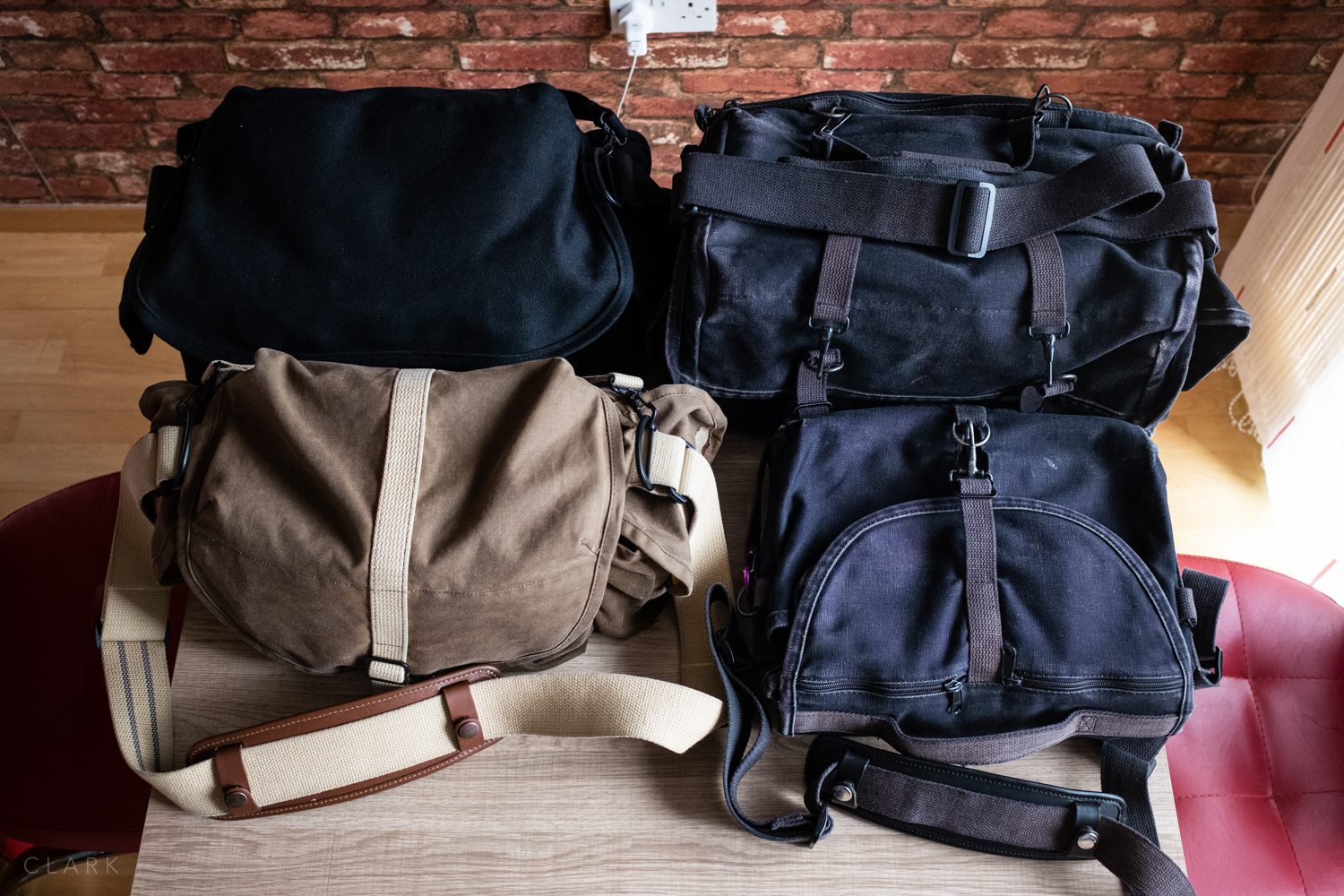
Domke F2 (top left), F-1x (top right), F-3x (bottom left and the F-803 (bottom right). All three black bags are canvas but the F2 is new.
DOMKE BAGS ARE MOREISH
Domke bags can get a little addictive once you have used one. It’s even worse in, like me, you have a natural affinity for really worn and even abused bags. Domke is sort of the Leica of camera bags. Just like an old M3 looks better with plenty of brass showing through the black paint, Domke bags look better the more scuffed and faded they become. I for one have spent far too many hours trolling Ebay for used and abused Domke’s.
Ruggerwear waxed canvas bags are sort new as they are made from a cloth material. The standard canvas bags are less pliable and take a while to break in but become soft like denin as time goes by.


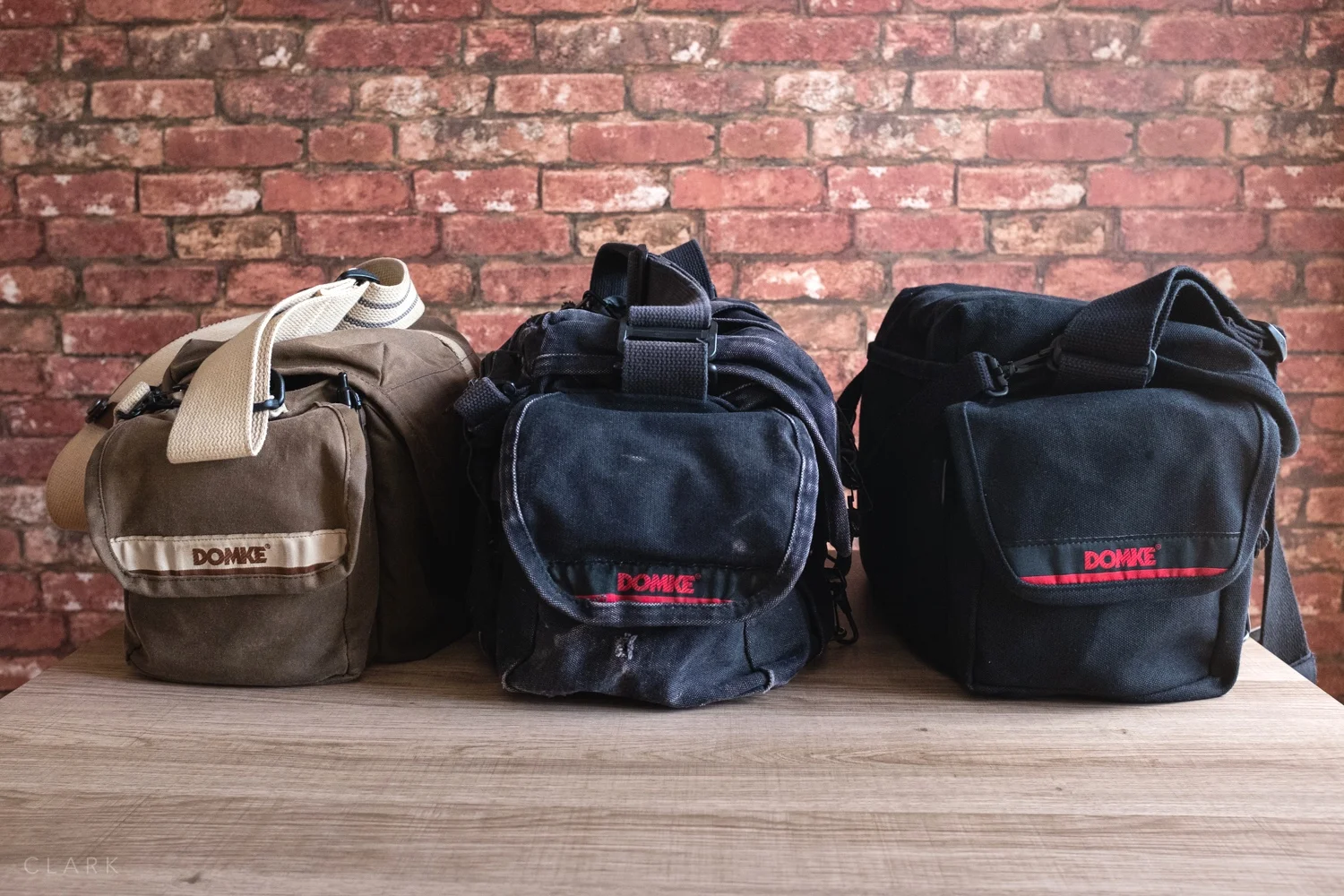
SIZE COMPARISON
There can often be some confusion over the size of Domke bags, so hopefully, the pictures above will help if you are considering one of these camera bags. The F2 is my work bag and holds a lot of kit, but it has to be packed in a specific way to fit in everything needed for a music shoot with an X-T3 & X-T2 kit. I will get round to doing a post about the F2 soon. In the meantime, leave any questions in the comments below and I’ll try to hep if I can.
You can buy the F-3X at Amazon UK
I also have a review of the small Domke F-5xb
Mad As A Box Of Frogs
Probably the least amount of explanation for these pictures would be best. Lets just say that humans are absolutely bonkers mad! But hopefully it won’t be too long until the dreaded Covid-19 has been defeated and we can all resume the craziness once more.


SHOT WITH THE FUJIFILM X-PRO2 & 35/2 & 50/2
Yuri Goloubev: Two Chevrons Apart

Back in May last year, I was shooting pictures for my labour of love jazz book that I have been working on for four years now. It’s a slow process and I feel lucky when I get to shoot a single great jazz musician for the book. But on the 12th of May 2019, I struck gold with three great musicians. The Tim Garland Trio featured the bandleader on tenor and soprano sax, Jason Rebello on piano and Yuri Goloubev on bass.
I arrived early and set up my background and lights for the portraits. One camera was ready with a trigger on the hot shoe and a second camera was set for the wide-angle documentary shots that were needed. The band arrived and one by one I shot the pictures needed. Yuri told me about a new record he was working on and that he needed some pictures for the CD. We sorted out the details and I told Yuri I would send him some pictures.
I stayed to shoot the gig and it was such a fantastic performance by all three musicians. The venue was The Merchants House in Glasgow and it was a spectacular setting for the tight acoustic trio. A few days later I send Yuri the pictures and then forgot about it. Until a couple of months ago when Yuri got in touch to tell me the CD would be coming out on the 17th of April 2020, but he wanted to send me a pre-release copy. Sure enough Jiffy bag showed-up in the post a few days later.
The CD will be released and sold by Basho Records and is available by clicking the link at the bottom of this page. Two Chevrons Apart was recorded at Artesuono Studios, Cavalicco, Udine, Italy and engineered by Stefano Amerio, and what an amazing job they have done. Yuri is joined by Tim Garland on soprano and tenor saxophone, John Turville on piano and Asaf Sirkis on drums. Each musician adds precisely the right ingredient to this simmering pot of delicious jazz. Now and again the heat is turned up but then settles back down to simmer, keeping you hungry for more.
Do your ears a favour and pick up a copy of this great album. It will be available from Basho Records from April 17th 2020 by clicking the button below.